


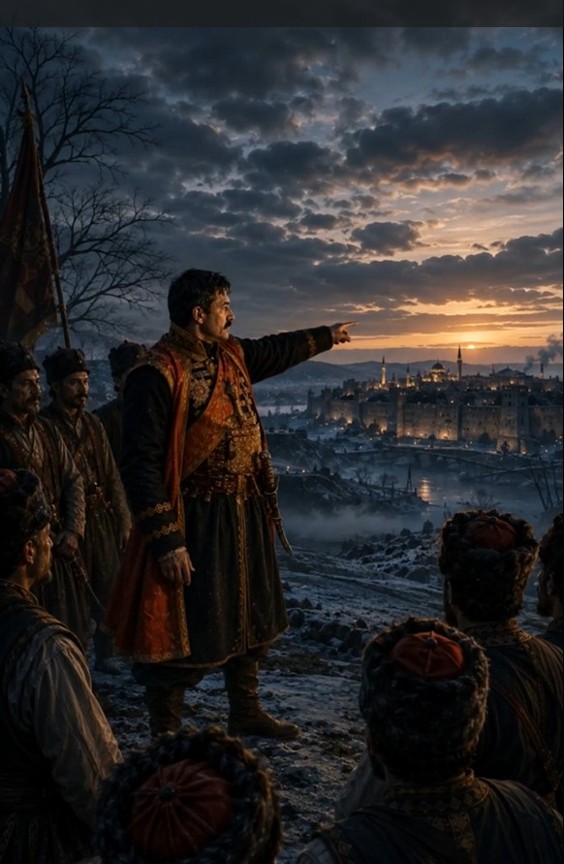
Today, Tašmajdan is one of Belgrade’s liveliest green oases. Thousands pass its paths daily, but few think that over two centuries ago, Serbia’s fate was decided right here. In December 1806, Tašmajdan was not a park, but a military position from which Karađorđe Petrović prepared the final assault on Belgrade, one of the most significant victories of the First Serbian Uprising.
Belgrade – Key to Serbia’s liberation:
When the First Serbian Uprising broke out in 1804, insurgents quickly liberated a large part of the Belgrade Pashalik. However, the greatest goal remained uncaptured — Belgrade. The city was the key Ottoman stronghold in Serbia. Its walls, fortress, and large garrison made it almost impregnable. Whoever held Belgrade controlled the pashalik politically and militarily. Karađorđe knew the uprising could not succeed fully without liberating Belgrade.
The camp at Tašmajdan:
During the final siege in late 1806, insurgents deployed positions around the city. One of the most vital was right on present-day Tašmajdan. There was no park, sports fields, or St. Mark’s Church then. The space lay outside city ramparts, offering an excellent view of Ottoman fortifications. From here, Karađorđe monitored city conditions, deployed men, and prepared the final attack. Historians note insurgents used natural hollows and caves of the old quarry as shelter from enemy fire and assembly points. Thus, Tašmajdan’s underground had military significance long before world wars.
A night that changed history:
After months of siege, the final attack was set for the night of November 29/30 Old Style (December 11/12 New Style), 1806. Under cover of darkness, insurgent units quietly approached ramparts to strike multiple points simultaneously. Prominent commanders led the assault, including Vasa Čarapić, Stanoje Glavaš, Miloje Petrović, and others. Vasa Čarapić led the storming of Stambol Gate, where he was mortally wounded, yet exhorted comrades to charge forward and capture the city before dying.
After nearly four centuries:
Fighting raged for hours from gate to gate along narrow streets. Losses were heavy on both sides, but insurgents broke Ottoman resistance. Capturing Belgrade in December 1806 marked the first time Serbs held their most important city since the fall of the medieval state in 1521. It was the climax of the First Serbian Uprising and symbol of statehood restoration. In subsequent years, Belgrade became the political and military center of insurgent Serbia.
Tašmajdan as a silent witness:
Today, almost nothing recalls the military camp located here 220 years ago. Yet right here, Karađorđe waited for the moment that changed Serbian history. Tašmajdan connects millions of years of geology with history that altered a nation’s destiny. Few places in Belgrade allow standing steps away from busy streets where one of the most significant operations of the First Serbian Uprising was led.