


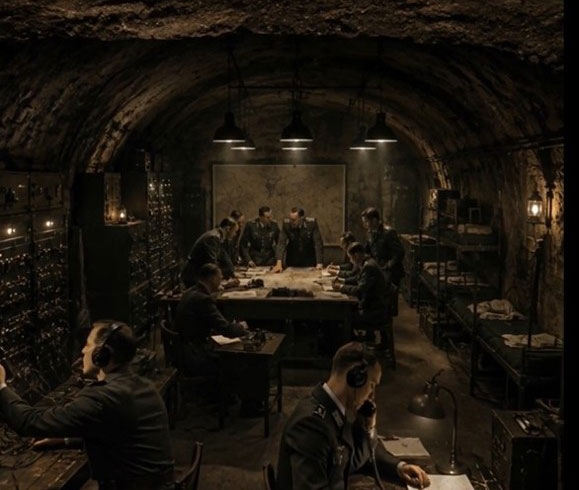
Today, thousands of people walk through Tašmajdan Park daily, unsuspecting that just a few meters beneath their feet lies one of the most intriguing military facilities from World War II. In the depths of the former quarry hides a subterranean complex converted during Nazi occupation of Belgrade into a Wehrmacht command center. Due to its association with German General Alexander Löhr, many still call it “Löhr’s Bunker”, although its true history is somewhat more complex.
From quarry to military facility:
Tašmajdan caves were not created naturally. For centuries, humans created them by extracting limestone to build Belgrade. Thus, a large system of galleries, halls, and corridors was formed beneath the park. When Nazi Germany occupied Belgrade in 1941, occupation authorities quickly realized such a space was ideal for a military site. Thick limestone layers provided excellent protection against bombing, while its central location enabled rapid communication with top military and administrative bodies. Thus, Germans began adapting the underground into a modern command complex.
What the bunker looked like:
Underground rooms were fitted out far more seriously than most people imagine today. Electricity was installed, ventilation systems were built, telephone connections were laid, and workspace and living quarters for officers were set up. The subterranean complex featured command offices, meeting rooms, storage facilities, and technical rooms allowing operation even during air raids. Stable cavern temperatures, remaining almost unchanged year-round, further suited military use. Thus, the bunker could function regardless of weather or surface bombardment.
Was this truly Löhr’s Bunker?
One of the most famous stories related to Tašmajdan is that German General Alexander Löhr, commander of German forces for Southeast Europe and one of the main figures responsible for the April 6, 1941 bombing of Belgrade, was stationed here. That is why the underground complex gained the popular name “Löhr’s Bunker”. However, historians caution that a distinction must be made between a popular name and reliable historical proof. To date, no historical sources confirm that Löhr resided in this bunker permanently or personally commanded all military operations in Yugoslavia from here. What is confirmed is that German occupation authorities used the Tašmajdan underground as an important military facility equipped for command, communication, and protection during potential Allied bombing.
Underground that survived the war:
After WWII, the bunker did not disappear. Most underground chambers remained preserved, alongside parts of installations, corridors, and specific rooms testifying to its wartime past. Today, part of the complex can be visited on organized tours, while certain corridors remain closed to the public. That is why the Tašmajdan underground continues to draw great interest from historians, researchers, and Belgrade history enthusiasts.
One place, four completely different histories:
Few places in Europe changed purpose so many times across centuries. 15 million years ago, a Pannonian seabed. Later, a quarry building Belgrade. In wars, caves sheltering thousands of citizens. During Nazi occupation, a military command center. That is why Tašmajdan is not just a park. It is a place reading almost all layers of Belgrade’s history — from millions of years of geology to ancient quarries and WWII’s darkest days. While passersby see trees and paths, beneath lies a subterranean world preserving stories of the city as it once was, of people who built, defended, and conquered it.