


At first glance, Tašmajdan is a peaceful place today. Children play, people stroll, athletes train, and the park is filled with life. However, over eight decades ago, air-raid sirens, bomb explosions, and cries of the wounded were heard here instead of children’s laughter. Few know that Tašmajdan saved the lives of thousands of Belgraders on that day.
A morning that changed Belgrade:
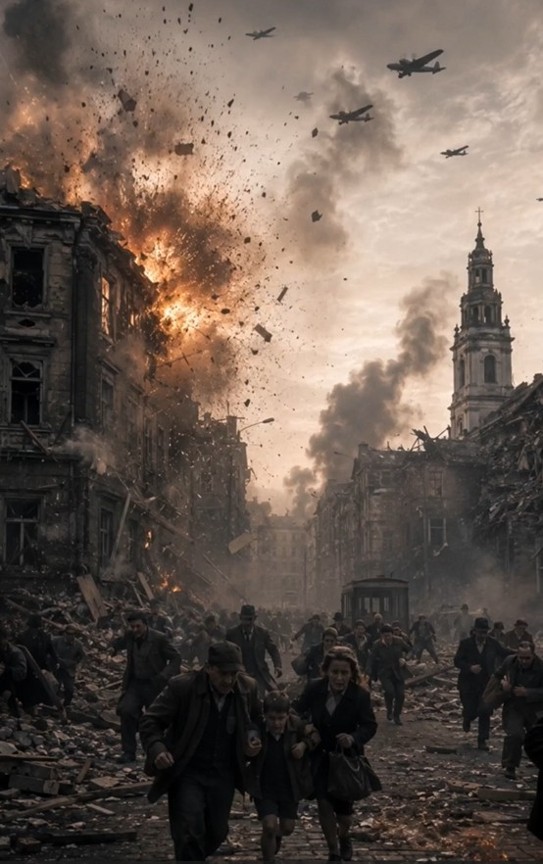
It was Sunday morning, April 6, 1941, around 6:30 AM. Without a prior declaration of war, German Luftwaffe planes launched Operation Punishment (Unternehmen Strafgericht), a massive bombing of Belgrade ordered by Adolf Hitler. The attack was a response to the March 27 military coup in Belgrade overturning the government that had joined the Tripartite Pact. Hitler decided the capital of the Kingdom of Yugoslavia must be brutally punished. Over several days of bombing, hundreds of tons of high-explosive and incendiary bombs were dropped. Entire quarters were destroyed; hospitals, schools, railway infrastructure, and state institutions were severely damaged. The greatest cultural loss was the destruction of the National Library of Serbia at Kosančićev Venac, burning an priceless part of Serbian cultural heritage.
Race to Tašmajdan:
As bombs fell on the city, thousands tried to find any shelter. One of the safest places was the Tašmajdan caves. Deep underground lay vast galleries of the former quarry, protected by thick limestone layers. Many Belgraders already knew about them, heading to underground entrances as soon as sirens sounded. There was no comfort in the caves. Dampness, cold, and total darkness prevailed. People sat on stone, clinging to one another as detonations shook the entire city above. Parents calmed children, elders prayed, and every blast meant another bomb hit Belgrade.
A city disappearing above their heads:
While people waited underground, one of the greatest tragedies in Belgrade’s history unfolded above. An estimated several thousand civilians died in the April bombing, with much of the city center turned to rubble. Thousands of buildings were destroyed or damaged, and fires consumed sections of the capital for days. For many families in Tašmajdan caves, that underground space meant the difference between life and death.
Underground with a new role:
Tašmajdan galleries changed roles for centuries. Created as a quarry building Belgrade, later storing ice and housing the poorest residents, wartime converted them to shelters. In WWII, German forces adapted parts into command quarters with power, ventilation, and phone lines. Today, remnants of those rooms remain preserved in parts of the underground.
A place that preserved hope:
Perhaps that is the greatest symbolism of Tašmajdan. 15 million years ago, a seabed. Later, a quarry building Belgrade. And then those same human-made caves became a sanctuary in one of the city’s darkest days. On April 6, they did not build new structures. They built something far more vital — the chance for thousands of people to see a new morning. That is why Tašmajdan is not just a park or geological site. It is a place where millions of years of natural history intertwine with the most dramatic human moments. When walking its paths today, it is hard to imagine that beneath them, in quiet stone galleries, entire families waited for one of the scariest bombings Belgrade ever suffered to stop.