


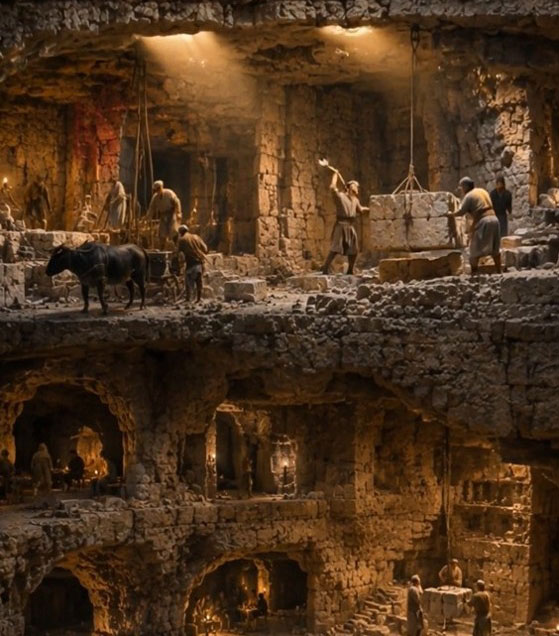
When walking through Tašmajdan Park today, it is hard to imagine walking over a spot that nearly two thousand years ago was one of the most important quarries of Roman Belgrade. Long before the modern city emerged, hammer and chisel blows echoed here as Roman craftsmen extracted stone from which a large part of Singidunum, the predecessor of modern Belgrade, was built.
Romans arrive on the Danube:
At the end of the 1st century AD, the Romans erected a large military camp, Castrum Singidunum, at the confluence of the Sava and Danube rivers, housing the famous Legio IV Flavia Felix. A civilian city soon developed around the camp with streets, thermae (baths), temples, workshops, and cemeteries. Building such a large settlement required vast quantities of quality construction material. Not far from the fortress lay the natural limestone massif of modern Tašmajdan — an ideal location for opening a quarry. Proximity to the construction site was a massive advantage. Stone did not need to be transported from distant regions, but could reach city walls and new buildings quickly.
Stone 15 million years old:
The irony of history is that the stone used by the Romans was not created in their era, nor even during the time of early humans. About 15 million years ago, the Pannonian Sea stretched across present-day Tašmajdan. Over millions of years, remains of corals, shells, snails, and other marine organisms settled on its floor, creating thick layers of limestone. The Romans began exploiting this exact stone. Thus, a sea that disappeared millions of years before humans appeared became building material for one of the most important Roman cities on the Danube.
How Roman Belgrade was created:
Work in the Tašmajdan quarry was manual. Stonemasons used hammers, chisels, and iron wedges to separate large blocks of limestone, processed them on site, and transported them by teams to Singidunum. Parts of city ramparts, towers, public buildings, roads, and tombstones were built from this stone. Many Roman sarcophagi and stone monuments found during archaeological research in Belgrade were crafted precisely from Tašmajdan limestone. Archaeologists found numerous traces of Roman extraction around Tašmajdan, confirming this area played an exceptionally crucial role in Singidunum’s growth.
A tradition lasting centuries:
The Romans were not the last to extract stone from Tašmajdan. After them, Byzantines used the quarry, followed by medieval Serbs. Under Ottoman rule, extraction expanded further, giving rise to the name Tašmajdan — from Turkish “taş” (stone) and “majdan” (mine/quarry). Limestone extraction continued into modern times until the 20th century. For over 1,500 years, stone was taken from this site to build walls, churches, houses, public buildings, and streets of Belgrade. Few quarries in Europe can boast such long continuity of exploitation.
The place from which the city arose:
Tašmajdan was never an ordinary quarry. It was the source of material from which Belgrade arose. First a coral reef in the warm Pannonian Sea, it became a Roman quarry enabling Singidunum’s development. Later, Byzantines, Ottomans, and modern Belgraders used the same stone while underground caves formed, serving as shelters and military facilities centuries later. Today, as we walk through Tašmajdan Park, we rarely think that beneath our feet lie rocks that shaped almost the entire history of Belgrade. Perhaps that is why Tašmajdan is one of the most special places in the capital — because here time did not just leave traces. Here time laid the city’s foundations.